
Grady's Current Owner Record
The AssuranceGov tax roll is Grady County's fastest current-owner record. The OWNER string sits beside the account and address fields in its parcel summary. Each view belongs to a single tax year. Check the year before trusting the name. The roll names the party carried on that assessment. It is not the occupant, and not a guaranteed title conclusion.
| Owner Name | The OWNER value carried on the chosen tax-year parcel card |
|---|---|
| Mailing Address | The destination used for tax correspondence |
| Situs | The physical property address shown by the roll |
| Last Sale Date | A sale clue where populated; the deed date still needs review |
| Deed Reference | Book/page or instrument clues when shown; confirm in GSCCCA |
Each Grady County parcel record carries more than a name. PARCEL, ACCOUNT NUMBER, BILL NUMBER, and PROPERTY ADDRESS all appear there. So do exemption codes, tax district, and Tax History. Those identifiers matter when two owners share a name. They also separate a land account from a different property type. The same owner can list both under one account.
See Grady's Owner Card
The Grady County parcel summary is the owner card. Its OWNER line, mailing address, property address, parcel, account, exemptions, and tax history sit together in a single record.
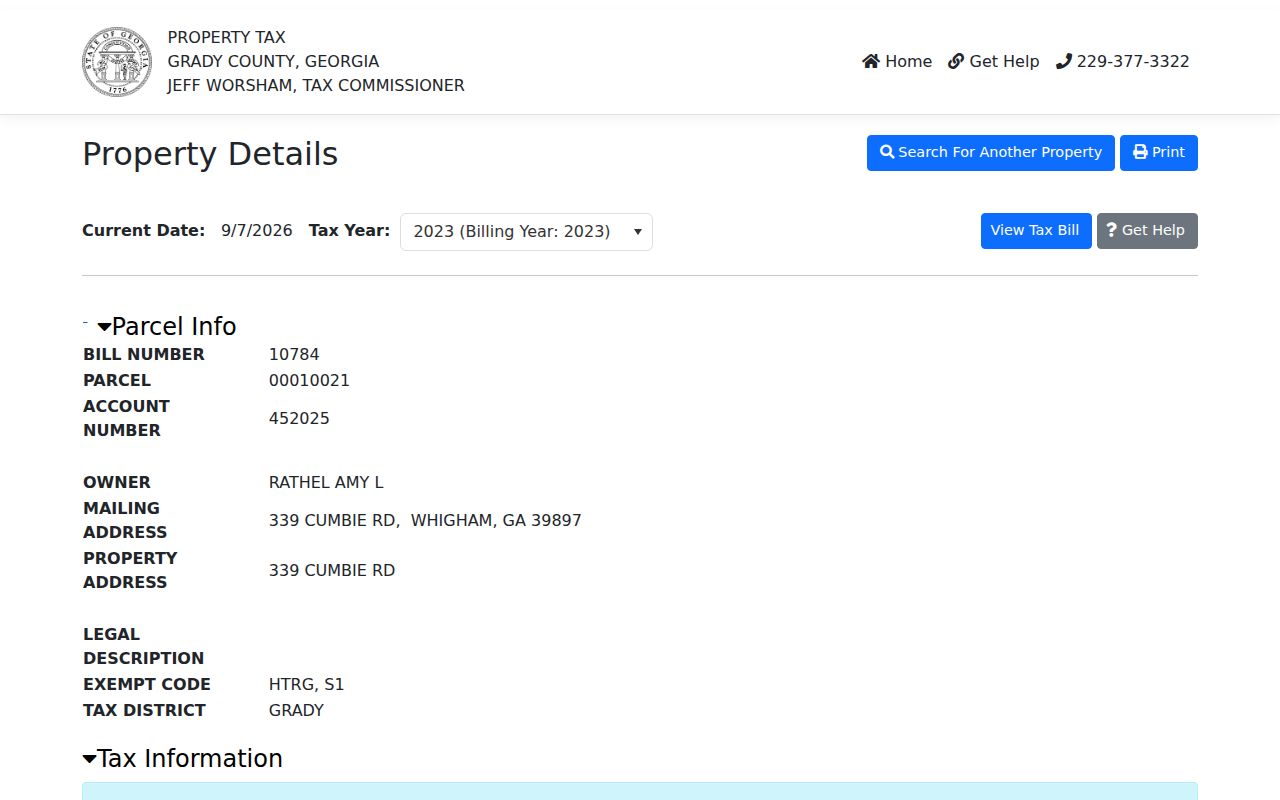
This Grady County card leaves the legal-description field blank. The gap is a reason to consult the recorded deed, not to assume the parcel lacks a legal description.
Grady Owner Mail Versus Situs
The county mails tax notices to the mailing address. The situs address marks where the Grady County land physically sits. They can match. They still answer different questions about the parcel. A distant mailing address does not place the owner's home, and a situs address does not say who receives the mail there.
Rural road wording, directionals, city names, and ZIP labels often vary between the roll, the GIS map, and the deed. Save every version. A Cairo or Whigham postal label does not settle municipal limits. Match the parcel number, account, tax district, and legal description before calling two addresses the same tract.
How Fresh Is Grady's Owner?
Grady County's portal offers tax years from 2002 through 2026. Every choice gives one tax-year view. The county publishes no fixed post-closing refresh interval. A deed recorded after the roll was cut can name a newer grantee. Compare dates. Never assume them.
Prior Tax History rows can hint when the displayed owner name changed. A hint is not proof. The recording date on the newest deed is the better current-owner check. An estate transfer, life estate, survivorship event, or parcel split can occur. Any of these can also leave the Grady County roll behind the present story.
Recent-sale check. The Grady County assessment roll can lag a closing. Confirm the present owner against the newest deed recorded by the Clerk of Superior Court.
Confirm Grady's Current Owner
The roll-to-deed check stays narrow and present-focused. It tests whether the newest recorded conveyance supports the assessor's current owner string, and it does not rebuild any chain of prior Grady County owners.
- Open the current tax-year parcel in AssuranceGov and copy the OWNER, parcel, account, situs, and mailing address.
- Search that owner as Grantee in the GSCCCA real-estate index, with Grady County selected.
- Open the newest plausible deed and match its legal description, grantor, grantee, date, and book/page to the parcel.
- Ask the clerk about later instruments or obtain a certified copy when the online image is unavailable or paid.
- Owner of record
- The party named by a given public roll or recorded instrument.
- Assessment roll
- The county's tax-year parcel and value record.
- Situs
- The physical location, which differs from a mailing address.
- Recording lag
- The time between a filed transfer and its appearance in another office's record.
Viewing GSCCCA images or printing copies can call for an account, and fees may apply. For direct help instead, call the Grady County Clerk of Superior Court at (229) 377-2912 or visit the office at 250 N Broad Street in Cairo.
Current Grady Entity Owners
A company, trust, estate, or trustee can be the current owner of record. Search the exact roll name. Try Company mode where it fits. The Georgia Business Search returns an entity's status, control number, registered agent, officers or managers, and filings. None of that proves the agent or officer personally owns the Grady County land.
Grady Probate Court may hold a will, an appointment, a petition to sell, or an order tied to an estate transfer. For a trust, the recorded deed names the trustee and the vesting language. Keep the entity record, parcel record, and deed separate. Align their names and dates before drawing conclusions.
Prior Grady Tax Years Signal Change
Tax History lists a year, owner or owners, total tax, paid status and date, appraised value, and assessed value. Walk back through earlier years. A current-owner string often appears there first, along with spelling shifts or an estate label worth searching in the Grady County deed index.
That year-to-year change is not a transfer date. Confirm it against the recorded instrument. Try the clerk's counter if the online path fails. The Georgia Archives and local historical collections hold older records, though they are not the first stop for a present owner.
Note: Save the tax year with every screenshot or note so an old owner field is never mistaken for a current Grady County result.
Rank Grady Ownership Evidence
Rank the evidence by weight. A GIS owner label is a map lead. The AssuranceGov OWNER value is the tax-roll statement. A GSCCCA index result summarizes a recorded instrument, while a deed image or certified clerk copy shows the instrument itself. Each Grady County source carries more weight as the question moves from finding a name to verifying present ownership.
Even a certified copy proves only what was recorded. It resolves no full title chain, easement, lien, survivorship right, or court order, so a Grady County purchase or dispute calls for a professional title examination.
Use Grady Owner Records Lawfully
The tax mailing address serves a real property question. It offers the public a lawful correspondence route, nothing more. The addressee may be an entity, an estate, a trustee, or an agent. It may not be the resident at all. Read it as correspondence, not residence. Keep any message tied to the parcel itself. Avoid publishing sensitive details about the people involved.
Lawful use. A Grady County current-owner record supports purchase, estate, tax, and boundary research. It must never be used to threaten, stalk, surveil, or harass a person.
The tax mailing address serves a real property question. It offers the public a lawful correspondence route, nothing more. The addressee may be an entity, an estate, a trustee, or an agent. It may not be the resident. Read it as correspondence, not residence. Keep any message tied to the parcel itself. Avoid publishing sensitive details about the people involved.
Access a Grady Owner Offline
Phone works when the portal does not. Call the Tax Assessor at 114 1st Street NE in Cairo, (229) 377-3325 ext. 3, if a result refuses to load. The counter is open Monday through Thursday, 7:30 a.m. to 6:00 p.m. Fridays it is closed. Give staff the full situs address, the owner spelling, the parcel or account number, and the tax year. One more question matters. Ask which roll year the answer comes from. An old roll can carry a stale owner of record.
The deed itself lives with the Clerk of Superior Court at 250 N Broad Street, Cairo, (229) 377-2912. A GSCCCA image may be missing. It may also be gated behind an account. The courthouse counter and its public terminal serve just as well. Request the newest deed by grantee, along with the book and page or instrument details. Ask whether any later filings exist. The owner of record may turn out to be an estate. Grady Probate Court at the courthouse may hold the appointment, petition, or order that explains the current name.
Some records need a formal ask. A targeted Georgia Open Records Act request can obtain a specific non-exempt roll or instrument. Neither office hands it over routinely. Name the record, the parcel, the date range, and the format you want. The law permits search, retrieval, and copying costs for eligible requests. A narrow request is cheaper and faster to process.
Keep a short evidence log. Record the portal name and the search date. Add the tax year and the exact owner spelling. Note every parcel key you used. When a staff answer changes a result, write down the office and the date. That habit keeps an outdated roll from being mistaken later for the current owner record.