
Identify a Grady County Owner
Start from what you know. An address, a parcel number, or even a bill number opens the door. The AssuranceGov property search takes any of those. The tax roll it returns names the current owner of record. GSCCCA indexes recorded instruments by party and county. It catches the grantee on the newest deed. Check both. One source alone can miss a recent conveyance or a name held by a company. The two together settle the question of who owns a Grady County parcel far better than a single lookup. The route from address to tax roll to deed is the shortest official path.
- Search the situs address in AssuranceGov and open the matching parcel card.
- Save the OWNER field, parcel, account, bill, mailing address, and property address.
- Search that owner as Grantee in the GSCCCA Real Estate Name Search, restricted to Grady County.
- Compare the latest deed's description, book/page, grantor, grantee, and recording date with the parcel clues.
One caution applies. A deed recorded after the selected tax year will not appear on that roll, so check with the clerk for anything filed later. This approach surfaces an owner lead, not a full title exam.
Read Grady's OWNER Field
The OWNER field sits near the top of the Grady County parcel summary, beside the mailing address, property address, parcel, account, bill, exemptions, and tax district. Tax History can show who held the parcel in earlier roll years. Treat the name as the assessor's owner of record for that year. It says nothing about who lives there. The AssuranceGov parcel summary places the owner and both address fields in plain view.
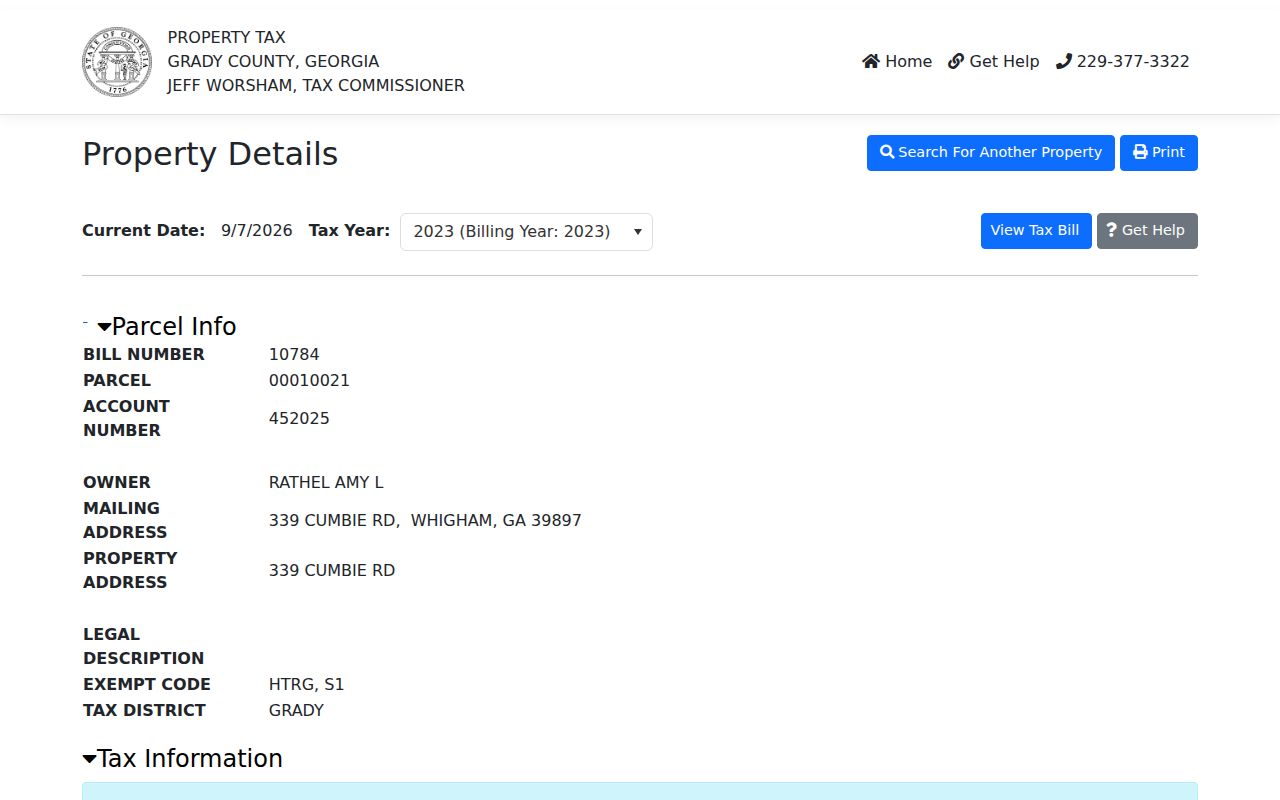
Identifiers matter as much as the name itself. One person can hold several accounts, and a blank legal description on the card does not mean the deed lacks one.
Cross-Key Grady County Ownership
A name by itself is a weak key. Consider one local parcel that appears four ways: GIS PIN 1-21.1, GIS PARCELNO 00010021001, assessor PARCEL 00010021, and account 452025. Record each value exactly as shown. Convert nothing. Then match the situs address and tax district. Only after that, compare the deed's land lot, district, subdivision, lot, block, acreage, and prior owner.
If two keys disagree, go back to the source and the year you selected. Agreement across several independent details beats a same-name match every time. The mismatch between map keys is a real feature of a Grady County search. It is not clutter.
Note: A mailing address is where notices go; the situs address identifies the land and may use different city or ZIP wording.
Sources Behind Grady Ownership
Each public source answers one narrow question about a parcel. The tax roll is fast and searchable by name. A deed records a single conveyance. The GIS map ties parcel attributes to a polygon on the ground. Grady County property records work best when you read several of these sources together, because no single one settles every ownership question in Grady County.
| Where ownership appears | What it gives | How current |
|---|---|---|
| AssuranceGov tax roll | OWNER, mail/situs, parcel keys | Tax-year snapshot; no fixed lag published |
| GSCCCA deed index | Grantee, instrument, date, book/page | Tracks recorded instruments |
| ArcGIS parcel layer | Owner display tied to a polygon | Update schedule not published |
| Clerk counter | Recorded deed and certified copy | Fallback for web gaps and fresh filings |
Online record images sometimes sit behind an account or a paywall. The Clerk of Superior Court at 250 N Broad Street in Cairo offers a direct counter route at (229) 377-2912. When a web record looks incomplete, ask the recorder's staff about the public terminal or book and page access to the deed records.
Grady LLCs, Trusts, and Estates
An owner of record in Grady County is not always a person. The tax roll may name a company, a trust, an estate, or a trustee instead. Repeat the property search in Company mode and copy the spelling exactly. The Georgia Business Search can return an entity's status, control number, registered agent, and officers or managers. It also lists filings. One caution applies. An agent's address is a contact point, not proof that the agent owns the land.
Trusts complicate things further. A trust may list only its trustee on the roll. An estate can stay there for years while probate work is pending. Grady Probate Court keeps wills, appointments, sale petitions, and orders. Search GSCCCA for deeds from estates, trustee deeds, quitclaims, and warranty deeds. Court orders can help as the facts require.
Recent Grady Sales Can Lag
The AssuranceGov portal covers tax years 2002 through 2026. Pick a year and you get a roll snapshot. It is not a live feed of closings. Grady County sets no fixed number of days between a recorded deed and an owner update, so compare dates before trusting any name on the list. Search the listed owner as grantee and open the newest match. A freshly recorded deed can postdate the roll. The GSCCCA FANS service sends free alerts when a subscribed name appears in transmitted real-estate, lien, or plat records, though it blocks nothing and proves no title.
Grady Owner Record Terms
Key terms separate the owner-finding route from a title conclusion.
- Owner of record
- The party named in the relevant public roll or instrument.
- Grantee
- The party receiving an interest under a recorded deed.
- Title
- The legal ownership interest, including rights and burdens a name hit may omit.
- Situs address
- The physical property location, distinct from the mailing address.
A grantee hit still needs review. Check for life estates. Survivorship language, easements, security deeds, and later court orders can each alter ownership, so a title professional should examine the full chain before any purchase or dispute.
Limits on Grady Owner Lookups
A public name answers only part of the question. It may hide interests or unrecorded claims. It cannot confirm who lives at the address, GIS lines do not prove boundaries, a tax bill never replaces the vesting deed, and protected data may be redacted under source-specific law.
Lawful use. Use Grady County owner records for purchase research, boundary questions, estate work, or civic review. Never use a public address to threaten, stalk, or harass anyone.
Certainty costs more effort. Request the deed from the clerk. Then check later liens, releases, assignments, plats, estate records, and court orders, keeping in mind that a certified copy proves what was recorded rather than that a complete title exam ever occurred.
Ask Grady's Record Keepers
Two Cairo offices split this work. The Tax Assessor keeps the parcel and assessment roll. Its office at 114 1st Street NE is open Monday through Thursday, 7:30 a.m. to 6:00 p.m., and closed Friday. Call (229) 377-3325 ext. 3 when a parcel, address, map, or owner string will not reconcile. The Tax Commissioner, at the same address, handles tax bills, payments, delinquency, and excess proceeds rather than the deed that vested title.
The Clerk of Superior Court records the warranty deed, quitclaim deed, estate deed, tax-sale deed, security deed, release, lien, easement, and plat. Deed history lives with the clerk. The clerk's office sits at 250 N Broad Street. Call (229) 377-2912 with questions. Ask when the online index omits an image. A new filing or the exact Grady-specific online cutoff also matters there. The GSCCCA page shows a system span beginning in 1990. That date reflects the broader system rather than a verified complete start for Grady County's deed records.
When Grady Web Searches Fail
A failed portal search is not the end. The owner record may still exist. Retry the name with initials, punctuation variants, starts-with matching, and company mode. Pull prior tax years for an earlier owner string. Land without a stable situs address is best searched by the exact parcel number. A rural mailing address can differ from the tract address. One search may return real-property and mobile-home accounts.
Deeds call for the courthouse terminal, counter, phone, or a targeted copy request. Estate-held parcels belong with Grady Probate Court at the courthouse, filed under the decedent or estate name. Older records begin in the clerk's deed books. Microfilm comes before broader historical sources. The Georgia Archives deed search, Roddenbery Memorial Library, and the local museum may help with former place names, but none replaces the current recorded instrument.
A narrow request under the Georgia Open Records Act can seek a specific non-exempt record that is not posted. Identify the parcel, spelling, record type, and date range. Permitted search, retrieval, and copy costs may follow the first statutory allowance.
Unexpected Grady Owner Changes
An owner change without a sale deserves verification, not a quick conclusion. Save the tax-year card. Compare signatures, legal description, book/page, recording date, and grantor. A lender, title insurer, attorney, or law enforcement should hear about it. That step applies when facts suggest an unauthorized transfer.
FANS is a notice tool for future transmitted records. Its statewide 2025 report counted nearly 85,000 users and 183,000 requests. It also logged more than 254,000 alerts by June 30, 2025. Enrollment does not hide a record or stop a filing. It gives the subscriber a prompt to inspect an unexpected instrument. The subscriber can then act through the proper office.
Keep the alert email, instrument number, and search date. Confirm the filing through GSCCCA or the clerk's published contact information. Never use a phone number supplied by an unknown sender.