
Start a Grady County Previous-Owners Timeline
A backward deed chain starts from one recent, certain conveyance. Every row should name the transfer. It should also give the next party to search. The illustration shows the working format only, not facts about any particular parcel.
| Transfer Date | Grantor to Grantee | Deed Type | Book/Page |
|---|---|---|---|
| Most recent recording | Seller to present grantee | Warranty, quitclaim, estate, or other deed | Copy exact reference |
| Earlier recording | Earlier grantor to that seller | Read the indexed instrument | Copy exact reference |
| Next prior transfer | Repeat with the new prior owner | Confirm legal description | Continue into older books |
Begin with the current owner as a grantee. A matching name proves little on its own. County, deed type, legal description, recording sequence, and the instrument image must all point to the same Grady County land before a name joins the timeline.
Use GSCCCA to Trace Grady County Former Owners
The official GSCCCA Real Estate Name Search takes Grantor, Grantee, or All Parties. It also accepts instrument type, county, a name, and an optional date range. Pick GRADY. For individuals, enter “last name, first name.” Results can include instrument type, book and page, subdivision or lot, street address, sales-price data, and document images where available.
The system covers a statewide span beginning in 1990. Grady County's exact “good from” date is a system boundary. It is not a promise about local images. Short names of two characters or fewer need a county, an instrument type, and a date range. That range can be no wider than one year.
See the Name Index Used for Grady County Prior Owners
Grady County researchers can trace prior owners through the official GSCCCA search form, which lets you search deed records by name and party role.
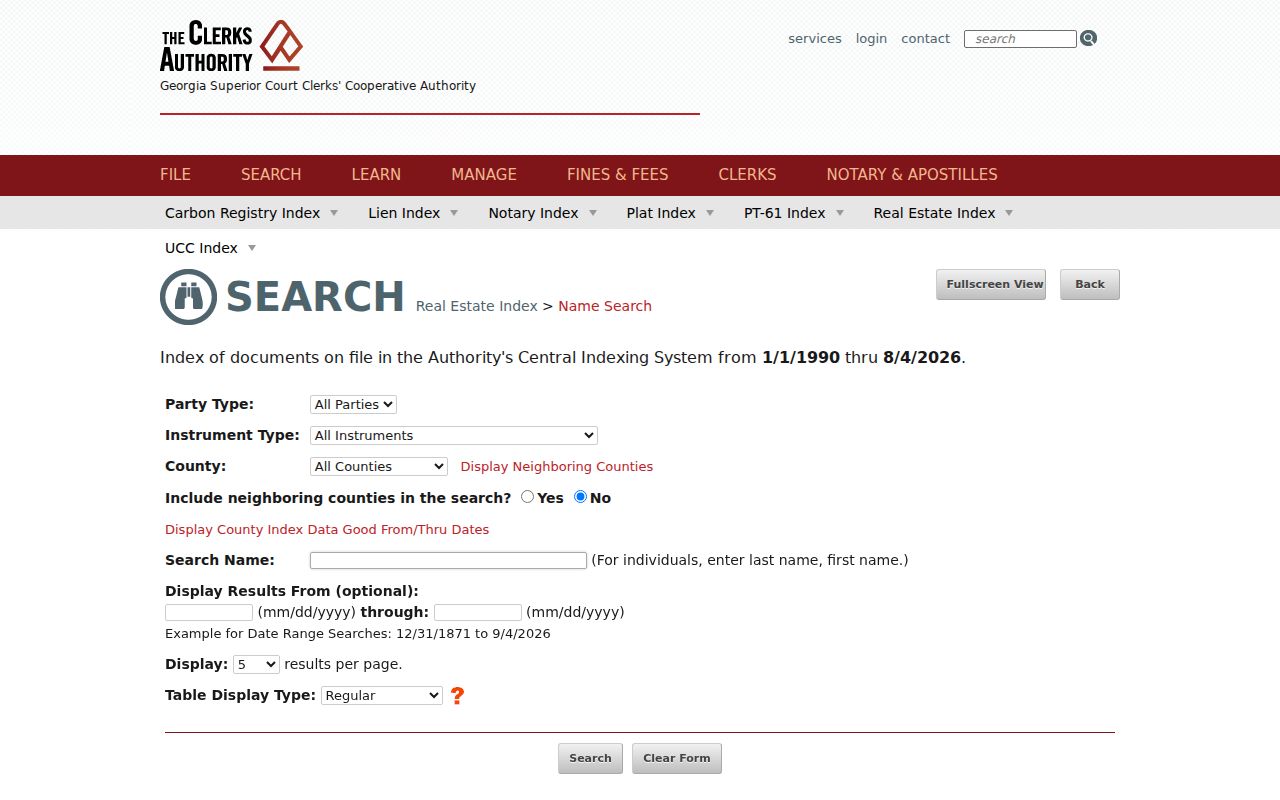
The form is only a doorway. A result points toward an instrument. The recorded image, or a certified clerk copy, supplies the text that confirms a Grady County ownership link.
Reconstruct Grady County Prior Owners Backward
Start at the current vesting deed and step backward through older deeds. This reverse order keeps an appealing historic name from landing on the wrong tract.
- Find the current owner on AssuranceGov, then locate that person or entity as grantee in the deed index.
- Read the vesting deed and record its grantor, legal description, book/page, instrument type, and recording date.
- Search that grantor as an earlier grantee. Try initials, spelling variants, married names, estates, and trustee names.
- Compare each legal description and reference. At the online limit, take the last book/page to the clerk vault or archives.
- Grantor
- The party conveying an interest in the recorded instrument.
- Grantee
- The party receiving the interest stated in that instrument.
- Chain of title
- The linked sequence of transfers affecting the same land.
- Reverse index
- An index organized to find grantors, useful when following a chain backward.
- Warranty and quitclaim deeds
- Different conveyance forms; neither label alone proves the whole chain is clear.
Let Book and Page Rescue a Grady County Name Search
Book and page can beat a name search. Clerks indexed misspellings, initials, married names, estates, and trustees under odd spellings. A reference sidesteps all of that. GSCCCA offers a separate Real Estate Book Page Search. Pull the exact reference cited in a later deed. Then compare legal descriptions.
Not every link in the chain is a warranty deed. Estate documentation, court orders, tax-sale deeds, sheriff's deeds, quitclaim deeds, and trustee's deeds can all explain a change among previous owners. A security deed or release only touches an encumbrance. It may not move the assessor's owner of record at all.
Move Older Grady County Former Owners Offline
Grady County dates to 1906. The first deed-book run and the local online cutoff are not pinned down. So the older chain calls for a deliberate handoff. Clerk Kaylee Page's recording office sits at 250 N Broad Street in Cairo. Ask staff to continue from a known book/page or legal description at the public terminal or in the deed books.
The Georgia Archives describes county deeds as records held by the Clerk of Superior Court. It also lists deeds held on Archives microfilm. Its Virtual Vault deed search works as a finding aid. It does not promise every Grady volume is online. FamilySearch catalogs land, deed, probate, and marriage books. But its catalog must be checked for the exact Grady County image run.
Online limit. GSCCCA shows a statewide system span from 1990, but Grady County's precise start is unverified; continue older work through the clerk and archives.
Use Cairo History to Identify Grady County Past Owners
Roddenbery Memorial Library can bridge an old name and a modern parcel. Its local resources include the Cairo Messenger Online archive covering 1904 through 1950. It also holds genealogy and local-history files, newspaper and church reels, yearbooks, photographs, and the “They Endure” oral histories. These can surface an older road name, family association, church, cemetery, or subdivision term.
Such clues support the chain without replacing it. A promising former owner may turn up in a newspaper or family file. Then go back to deeds, plats, and tax records for the land link. Grady County Museum & History Center also offers research help. Its collections are tied to the county's rail and downtown past.
The library sits at 320 N Broad Street in Cairo. It lists genealogy and local history among its services. Its newspaper span overlaps the county's creation. That helps when an early deed names a family, farm, church, or community instead of a street address. Search notices, obituaries, advertisements, and civic reports for the same surnames and place terms found in the deed books. Note the publication date and page. Then test the clue against a recorded legal description. Museum research can explain rail, commercial, and downtown references. Cite it as context, never as a conveyance in the legal chain.
Know Where Grady County Ownership History Ends
Every ownership chain in Grady County stops somewhere. The county formed in 1906. An older link often sits in a parent-county deed book or an archives collection. Plats can tie lot-and-block wording back to a larger tract. Probate files may explain a transfer through inheritance. The Clerk of Court holds the authoritative record. Confirm any claim about an earliest owner of record with that office before relying on it.
Image access is not always free. GSCCCA limited-use access can involve a $5 event plus $0.50 per printed page. A single-use session lasts four consecutive hours. Check current pricing before purchase. For evidentiary use, request the image or a certified copy from the Clerk. An index hit alone is not the deed itself.
Build the file like an audit trail. For each prior owner, record the exact indexed name, party role, and instrument type. Note the deed date if shown, the recording date, and the book/page. Keep spelling variants as written rather than silently correcting them. Copy the legal description word for word. Acreage, land lot, district, subdivision, block, and lot terms may separate two transfers inside one family. When an estate or trust shows up, inspect the instrument that authorized the transfer. Use probate material only to explain the break. When a parcel was divided, the earlier owner may have held a larger parent tract. Match the conveyed portion instead of trusting the surname alone.
Recording history is not occupancy history. A deed names the parties to a land interest. It proves neither party lived there, built the house, or shared a mailing address. Tax rolls, directories, newspapers, permits, and oral histories answer those separate questions. Keeping the questions apart keeps a Grady County previous-owners timeline accurate, and it makes any gap easy to explain.
Lawful use. Research former owners for house history, estate work, or property diligence. Never use a living person's record to stalk, harass, intimidate, or cause harm.