
What Grady County Property Tax Records Show
Each Grady County property tax record blends assessor data on value and exemptions with what the commissioner's office bills and collects. Read every field with its year, district, and parcel reference in view.
| Record Field | Meaning for That Year | Official Source |
|---|---|---|
| Owner, parcel, account, situs | Tax-roll identity and cross-keys | Tax Assessor / AssuranceGov |
| Land and building value | Components of fair-market or appraised value | Assessment and tax bill |
| Assessed value | Statutory assessment-level amount before exemptions | Tax Assessor |
| Exemption and taxable value | Relief applied and the remaining tax base | Assessor and bill |
| Millage and net tax | Rate by entity and resulting charge | Tax Commissioner bill |
| Paid status and date | Payment history for the account and year | AssuranceGov tax history |
A bill is not a deed, a survey, or a market appraisal. It records how public tax figures were applied to one account for one year.
Owner and mailing fields route the account. They do not settle title questions. Parcel and account numbers work better as cross-keys. The GIS may display its PIN or PARCELNO in a different format. Keep exemption and district labels exactly as shown. They explain part of the calculation. But any eligibility claim needs the current county program rules behind it.
Assessor and Commissioner Have Separate Roles
Chief Appraiser Wendy Sadler and the Tax Assessor's staff handle appraisal, classification, mapping, returns, and exemptions. The office is at 114 1st Street NE, Cairo. Call (229) 377-3325 ext. 3. Published hours run Monday through Thursday, 7:30 a.m. to 6:00 p.m., with Friday closed.
Tax Commissioner Jeff Worsham works from the same address. Reach that office at (229) 377-3322 or jworsham@gradyco.org. It issues and collects the bills. Payment, delinquency, tax execution, sale, and excess-proceeds questions also belong there. A value or exemption dispute goes to the assessor. Keep the two offices straight.
For a mailed or open-records request, specify the parcel, account, tax year, and record wanted. Ask for the non-exempt portion and a cost estimate when the file is not readily available. Under the Georgia Open Records Act, the county generally must respond on status, cost, and timing whenever records cannot be produced within three business days.
Look Up a Grady County Tax Bill
The AssuranceGov portal accepts Name, Bill #, Company, Parcel, and Address searches. Its year selector covers 2002 through 2026 plus ANY.
- Select the target tax year before entering the address or parcel.
- Open the correct row by comparing account, parcel, property type, and situs.
- Read the summary's owner, exemption, district, appraised value, and assessed value.
- Open View Tax Bill and note billing date, due date, taxable value, millage, and net tax.
- Open Tax History for year, owner, total tax, paid status/date, appraised value, and assessed value.
- Fair-market value
- The assessor's full-value figure used in the tax framework.
- Assessed value
- Georgia generally assesses taxable property at 40 percent of fair market value.
- Millage
- Tax rate expressed in mills and applied to taxable value.
- Homestead exemption
- Qualified relief tied to a primary residence and filing rules.
- Tax lien or execution
- A collection claim or process that requires current commissioner and recorded-file confirmation.
Read a Grady Tax Bill Line by Line
The 2025 real-property bill for parcel 00010021 shows how the figures relate. Building value is $49,745 and land value is $5,255. That gives total fair-market value of $55,000 on 1.95 acres. Assessed value comes to $22,000.
County Tax and School Tax sit on separate rows. Each row uses $55,000 market, $22,000 assessed, $2,000 exemptions, and $20,000 taxable value, with the county at 12.6400 mills for $252.80 net and the school at 11.8000 mills for $236.00. Total millage reaches 24.4400, and net tax is $488.80. These sample figures belong to one account and year, not countywide permanent rates.
See a Grady County Tax Bill
The official sample tax-bill screen displays value components, exemptions, entity rates, and net tax.
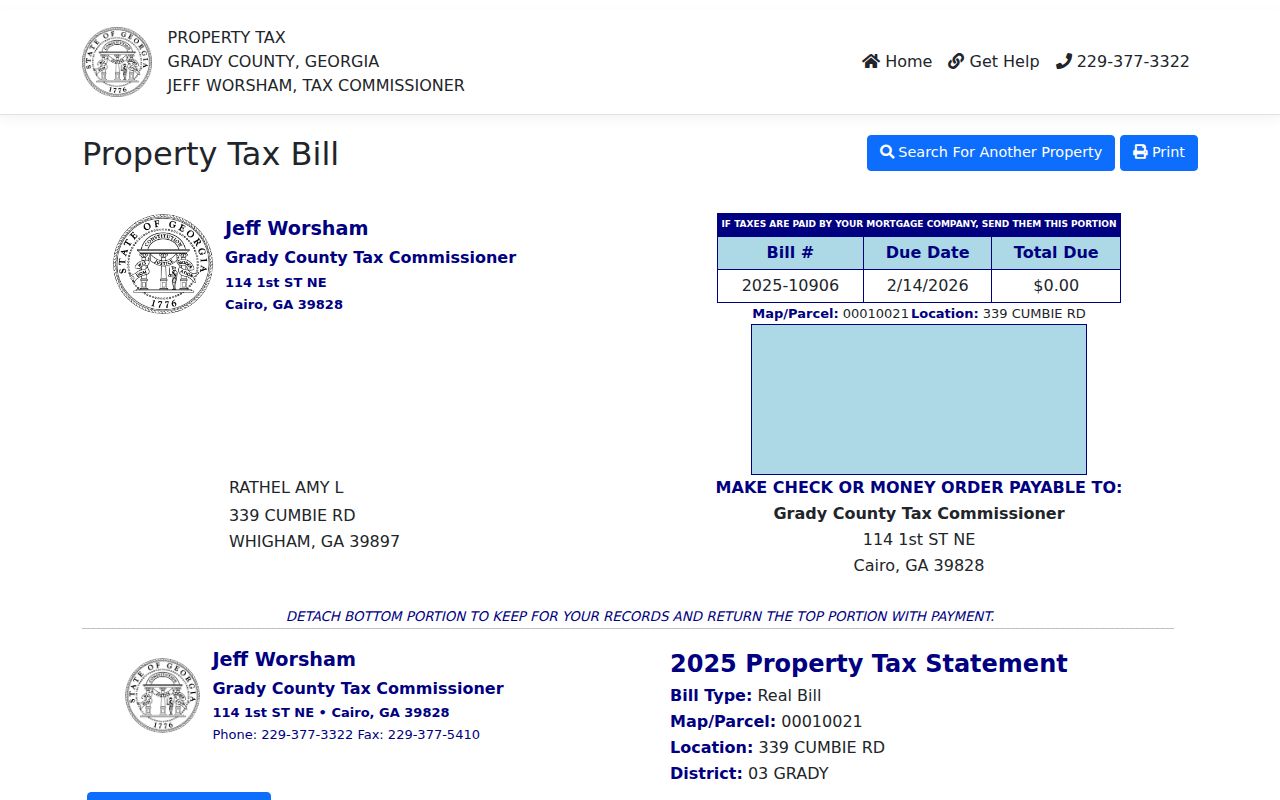
The tax bill screen splits county and school charges into distinct rows. That layout shows how one taxable value can carry more than one entity's rate.
The same screen lists bill type, map-parcel, location, district, owner, billing and due dates, acres, and exemption labels. A payment-history link sits there too. Save the full bill. Quoting only the net tax hides which figure changed and which entity applied a rate. A rollback-savings line belongs to that dated bill alone. Do not generalize it to another parcel.
Georgia's 40 Percent Rule in Grady
Georgia law generally puts assessed value at 40 percent of fair market value under O.C.G.A. §48-5-7. The sample fits: 40 percent of $55,000 is $22,000. Exemptions then shrink the taxable amount each entity uses.
Assessed value is not an expected sale price. Nor is it a private appraisal. A recorded deed or PT-61 consideration offers a separate sale clue, while the assessor's value serves the property-tax system alone. The Grady County property value guide explores those differences.
Grady Homestead and Agricultural Filing Dates
The assessor page links both the county homestead form and the assessment-appeal form. Homestead filing runs from the day the property becomes the owner's primary residence through April 1 of the next year under O.C.G.A. §48-5-44. Returns are due January 1 through April 1. So are Conservation Use and Preferential Agricultural Assessment applications.
Eligibility depends on current program rules. Use the current county form, and ask the assessor about any code shown on the account. A displayed code alone proves little.
Note: Confirm the current form, supporting proof, and filing date with the Grady Tax Assessor before relying on prior-year instructions.
Appeal a Grady County Assessment
Assessment appeals go to the Board of Tax Assessors. The state PT-311A instructions allow 45 days from the assessment notice to file. Identify the parcel and taxpayer, preserve the notice date, choose a permitted appeal route on the current form, and submit evidence on value, uniformity, or taxability.
Useful evidence includes the county card, photographs, and comparable property records. A survey or appraisal can help when relevant. So can proof of a wrong classification. Keep delivery evidence. If electronic filing is allowed, use the address the county states rather than assuming an email submission works.
Forty-five-day appeal window. File with the Grady County Board of Tax Assessors within 45 days of the assessment notice; a call alone does not preserve the appeal.
Grady Payment History and Due Dates
On AssuranceGov, the parcel card opens a Tax History tab. The bill itself offers a View Payment History option. Each history row carries the year, owner, and total tax. It also shows a paid indicator with its date, appraised value, and assessed value. One sample from 2025 showed $488.80 paid on February 2, 2026. The bill listed February 14, 2026 as its due date. Treat those figures as illustrations of the format, not as your account.
For a live balance, delinquency, execution, or receipt, pull the actual account and year. Then contact the commissioner. The office publishes no current fee for an official tax copy. So ask before ordering one.
Before flagging a value change as an error, compare adjacent years. The sample history held steady at $55,000 appraised and $22,000 assessed for 2024 and 2025. That followed a 2023 assessed figure of $18,142. Reassessment, changed parcel facts, or a record correction can all explain the shift. The history itself names no cause. Its owner column remains a tax-roll field, not a deed chain.
Tax Sales and Grady Excess Funds
The Tax Commissioner posts an Excess Funds Report rather than a live delinquent-parcel inventory, and it omits most delinquent parcels, every auction, current title, and redemption status. The 2025 report lists date, map-parcel, owner, purchaser, and funds. It tracks money left over after identified sales.
Different official PDF versions have carried different totals. Preserve the report date and version you rely on. The commissioner can supply the current sale notice, execution, redemption status, purchaser record, and excess-funds procedure. Then run any tax-sale deed or later conveyance through the Clerk and GSCCCA, since a published notice and a completed recorded transfer are different events.
Grady County offers no stable live delinquent-tax list or auction calendar. A narrow Georgia Open Records Act request works when the record is not posted. Name the map-parcel, account, billing years, and record sought.
Separate four dates in any distressed-tax review. These are the bill or delinquency date, the execution or notice date, the advertised sale date, and the recorded deed, redemption, or excess-funds date. The excess report covers only part of that. Search the parcel in AssuranceGov and GSCCCA first. Then ask the commissioner which step is current. That discipline keeps an old report entry from becoming a claim about today's ownership or sale status.
Limits of Grady Property Tax Records
A current bill names the tax-roll owner. For a conveyance, the latest recorded deed remains the confirmation route. A paid balance does not establish clear title or release every lien. GIS lines prove no surveyed boundary. An excess-funds row is not a listing of property for sale.
Build a dependable file piece by piece. Save the parcel summary, selected-year bill, payment history, assessment notice, and any appeal decision as separate items. Add the recorded deed only when ownership matters. Each item answers a different question and carries its own date, custodian, and legal effect.