
What Grady County Deed Records Show
The Grady County Clerk of Superior Court serves as Georgia's local recording office for deeds and instruments affecting land. Each recorded deed names the parties. It also describes the tract and supplies a durable book-and-page reference, while related filings may explain financing, access, restrictions, or a later release.
| Deed Type | Recorded Effect | Typical Trail |
|---|---|---|
| Warranty deed | Conveys the stated interest with warranties in the instrument | Purchase and later resale |
| Quit claim deed | Conveys whatever interest the grantor has | Interest cleanup or family transfer |
| Deed from estate | Records a transfer connected to an estate | Probate file and executor or administrator authority |
| Tax sale or sheriff's deed | Records a conveyance following a stated sale process | Sale file, notices, redemption issues, and later deeds |
| Security deed | Secures a debt rather than serving as the ordinary sale deed | Assignments, cancellations, and releases |
Instrument labels carry real weight. A security deed does not mean a debt remains unpaid, and a tax-sale notice does not prove title transferred. Check later recordings before drawing any conclusion.
The GSCCCA index reaches beyond warranty and quitclaim deeds. Its menu covers deeds of gift, foreclosure deeds, trustee's deeds, right-of-way deeds, timber deeds, leases, powers of attorney, boundary agreements, restrictive declarations, and court orders. The label is only an index clue. A quit claim may pass a narrow interest, and an estate deed may rest on Probate Court authority. A sheriff's or tax deed can lead to later redemption or title litigation, so the document itself decides.
Grady County's Recording Office
The Clerk of Superior Court handles deed records for Grady County. Clerk Kaylee Page's office sits at 250 N Broad Street in Cairo, Georgia 39828. Call (229) 377-2912, or fax (229) 377-7078. The office records instruments that create or affect interests in land. It also serves the county's Superior, State, and Juvenile Courts.
Grady County has no separate recorder-of-deeds office. Ask the Clerk about a public terminal search, an available image, or a plain copy. Ask also about a certified copy. The office publishes no current fee table for copies and certifications. Call ahead before ordering or mailing payment. When you request a deed, provide the party names, the approximate year, and the instrument type. Include a book/page or instrument number if you have one.
Search Grady Deeds in GSCCCA
The GSCCCA Real Estate Name Search is the main online index for Grady County deed records, and the tax-roll owner makes a likely first grantee. The index is party driven. Set the county to GRADY.
| Search Field | Choice or Format | Why It Helps |
|---|---|---|
| Party Type | All Parties, Grantor, or Grantee | Separates conveyance out from conveyance in |
| Instrument Type | 38 listed choices | Narrows deeds, releases, easements, liens, or other filings |
| County | GRADY or statewide list | Removes unrelated same-name results |
| Search Name | Last name, first name; up to 70 characters | Finds an indexed individual or entity |
| Date range | Optional mm/dd/yyyy pair | Limits the likely transfer period |
| Display | 5 to 100 rows; three table formats | Makes broad results manageable |
Short names need tighter filters. Any name of two characters or fewer requires the county, an instrument type, and a date span no longer than one year. Neighboring-county search is for true cross-county land.
The docket can expose much more than names. Look for book/page, subdivision and lot data, street address, sales-price or PT-61 clues, daily transactions, and document images. Not every field appears on every hit. Record a blank as blank and open the image, because an index omission never proves the deed lacks the fact.
See the Grady Grantor-Grantee Screen
The official GSCCCA name-search page shows party type, instrument, county, name, and date in a results table with count and paging controls.
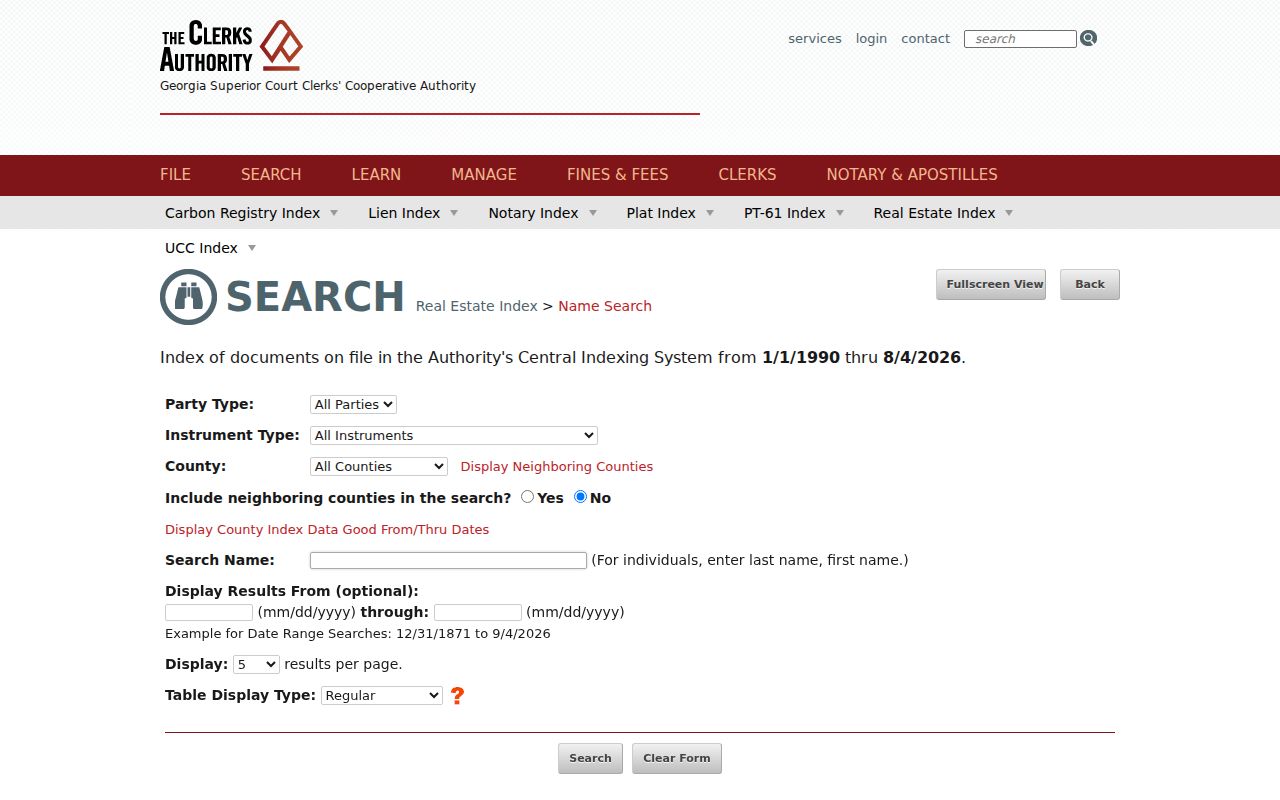
An owner name alone is not enough. The screen shows why. County, role, instrument, and date turn a broad name hit into a tract-specific lead. Capture the index row before buying any image. The comparison set includes party role, instrument label, date, county, book/page, subdivision or lot clue, and any address or sales-price field. Dates can mislead. If two hits look plausible, open both descriptions rather than trusting the newest record on date alone, because parcel splits and combined tracts can leave a later filing covering only part of the land.
Build a Grady County Chain of Title
Rebuild a Grady County chain of title from the current conveyance backward. Never jump between people without confirming the same land description and recording references.
- Find the latest likely owner on the selected assessor roll.
- Search that person or entity as grantee and open the likely acquisition deed.
- Record the grantor, grantee, deed type, date, book/page, and full legal description.
- Search that grantor as an earlier grantee and repeat the comparison.
- Move to Clerk books, Archives microfilm, or parent-county records when online coverage ends.
- Grantor
- The party conveying the stated interest.
- Grantee
- The party receiving the stated interest.
- Chain of title
- The ordered sequence of conveyances for the same tract.
- Book/page or instrument number
- The recording reference used to retrieve a filed document.
The Grady Online Date Is Not the Local Cutoff
The online dates can mislead. GSCCCA's live form displays a system span beginning January 1, 1990, and the statewide overview describes real-estate indexing since at least January 1, 1999, with historical additions still continuing. Grady County's own coverage may differ. Neither statement proves the first searchable or imaged year for local deed records. Use the web index for what it returns. Ask the Clerk about Grady's current Good From date. Log the name spellings, instrument filters, and dates already checked, confirm image availability, and counter staff will never need to repeat a broad search, making any negative result easier to evaluate.
Note: A statewide system date must not be reported as Grady County's verified first deed year.
Older Grady Deeds Cross County Lines
Grady County formed in 1906. Carved from Decatur and Thomas counties, its oldest chains may continue in parent-county deed books. The courthouse built in 1908 burned in 1980. Do not assume every early deed record was destroyed. Ask about surviving volumes, duplicate records, and microfilm. The Georgia Archives deed search and Archives microfilm are documented fallbacks. FamilySearch and Roddenbery Memorial Library can surface old names, newspaper notices, and address clues, but neither replaces the recorded instrument. The library's Cairo Messenger coverage from 1904 through 1950 points to sheriff's sales, estate notices, and subdivision advertisements.
Liens and Plats Beside Grady Deeds
A Grady County deed search should reach past warranty deeds. GSCCCA indexes security deeds, assignments, releases, cancellations, liens, materialman's liens, easements, and right-of-way deeds. Restrictive covenants, boundary-line agreements, court orders, plats, and estate documents appear there too. The full chain matters.
Trace each assignment to the next holder. Then look for a later release or cancellation. Match an easement or plat against the deed's legal description, since a map line does not erase a recorded right of way. A paid tax bill will not release a separate security deed either. Questions of legal priority or marketable title belong with a Georgia title professional or attorney.
Liens complicate the index. A lien can be filed against a person or company rather than a parcel, so a common-name search may pull filings against unrelated land. Search the borrower, lender, current owner, and entity variants. Then compare county, date, book and page, and legal description. For estate transfers, check Probate Court for the appointment, petition, or order behind the conveyance. The paper trail must support the deed itself.
Grady Owners Can Use FANS Alerts
Georgia's free Filing Activity Notification System sends an alert when matching clerk index information reaches the system. A registrant picks the name, address, and document-type terms to monitor. Grady County owners can register for this early warning at no cost.
FANS is not a block on recording and not a title search. It is only a heads-up. By June 30, 2025, the statewide service reported nearly 85,000 users. It also logged 183,000 notification requests. Alerts topped 254,000. If a notice looks wrong, obtain the instrument. Contact the Clerk and any involved lender or title professional. Report suspected fraud through the proper authorities.
Get a Grady County Deed Copy
Online account access may expose index summaries and document images. GSCCCA lists a limited-use image or printing event at $5 plus $0.50 per page. That fee buys a four-hour single-use session. Premium access runs $29.95 per user each month. Prices can change, so confirm on the live service before paying.
For an official copy, bring or send the recording reference to the Clerk of Superior Court. Ask whether you need plain or certified form. If the web image is missing, the record may sit at a public terminal, in a deed book, on microfilm, or under an alternate name. The broader Grady County property search guide explains how to gather the initial parcel and owner cross-keys.
Mail requests work best with full detail. Identify Grady County, both party names, and the instrument type. Include an approximate recording date. Add the book and page or instrument number. Ask the office to quote copy, certification, postage, and accepted-payment costs; the clerk publishes no local fee schedule. For very early land, include the parent county and the year range. Keep the clerk's certification page with the document rather than separating it from the copy.
Recorded, not guaranteed. The deed index shows filed instruments. It is not a title opinion, and an unrecorded interest, indexing error, unresolved lien, or boundary conflict may still require professional review.